Some organizational, market, financial, and implementation specifics have been intentionally omitted or generalized because of their strategic and confidential nature. The experience described below reflects an implemented Baldrige Executive Fellows’ capstone within a Midwestern health system.
Philip’s Baldrige Executive Fellows capstone focused on a practical challenge: how to create a more deliberate approach to rural specialty access, beginning with cardiovascular services. The work was not intended to develop a theoretical hub-and-spoke model. It created a way to test hypotheses that leaders already suspected about outreach performance, market opportunity, patient access, and the value of different clinical delivery models. Applying the framework across more than three dozen distinct communities created proof points that could be compared market by market rather than relying on anecdote, historical outreach patterns, or a single systemwide assumption.
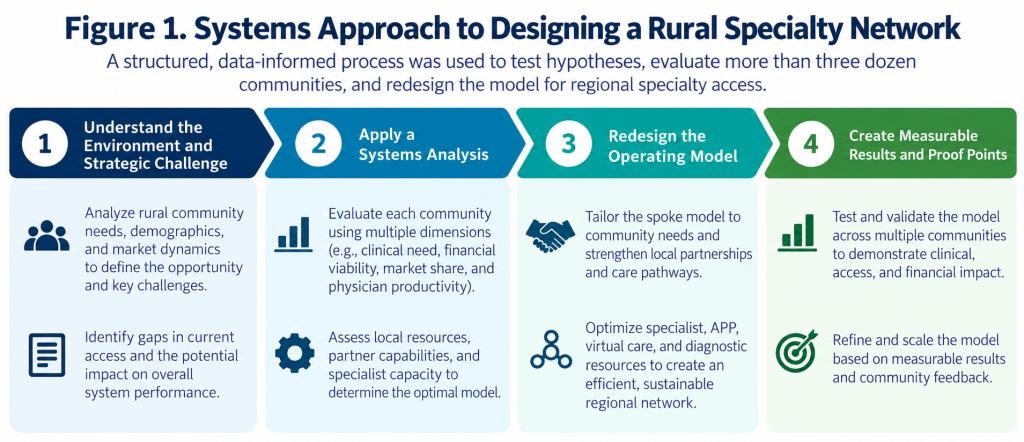
The starting point was recognition that the existing measures were insufficient for the decisions being made. Population growth was occurring unevenly across the region, inpatient and outpatient market share were changing, and there was no consistent set of leading indicators or formal process for understanding the overall impact of an outreach location. Rather than beginning with the historical clinic footprint, Philip’s work started with where patients lived, where they sought care, what clinical capabilities existed locally, and how patients moved between communities and the regional health system. Primary and secondary service areas were established using actual inpatient and outpatient patient-origin patterns rather than relying only on administrative boundaries.
Testing the model community-by-community demonstrated that the outreach clinic itself was not the right unit of strategy, the patient pathway was. Cardiovascular services were selected as the pilot because of the breadth of the outreach footprint and the service line’s meaningful contribution to the broader system. New unique patients became a leading indicator, and individual communities were evaluated across financial performance, market share, growth, population, utilization, and physician productivity. Applying the same framework across more than three dozen communities made it possible to distinguish patterns from exceptions and test whether assumptions about a market were actually supported by the data.
One hypothesis the work helped test was whether physician productivity should serve as the primary indicator of outreach value. It did not. wRVUs remained useful for understanding physician activity and capacity, but they did not explain whether the network was reaching new patients, improving access, completing referrals, reducing leakage, or supporting the right clinical pathway. A high-wRVU clinic could add relatively little incremental network value, while a lower-volume location could be important because it established new patient relationships, supported local diagnostics, connected patients to advanced intervention, or allowed longitudinal care to remain closer to home.
The financial analysis therefore moved toward the net contribution margin of the complete clinical pathway, including the fixed and variable costs required to serve each community. That meant looking beyond the professional encounter to physician and APP capacity, travel, staffing, facility and diagnostic expense, referral and scheduling infrastructure, and the downstream resources required at the regional hub. It also meant recognizing the opportunity cost of specialist time. A specialist day deployed to a rural community is not simply a travel expense; it is constrained clinical capacity that cannot be used somewhere else in the network.
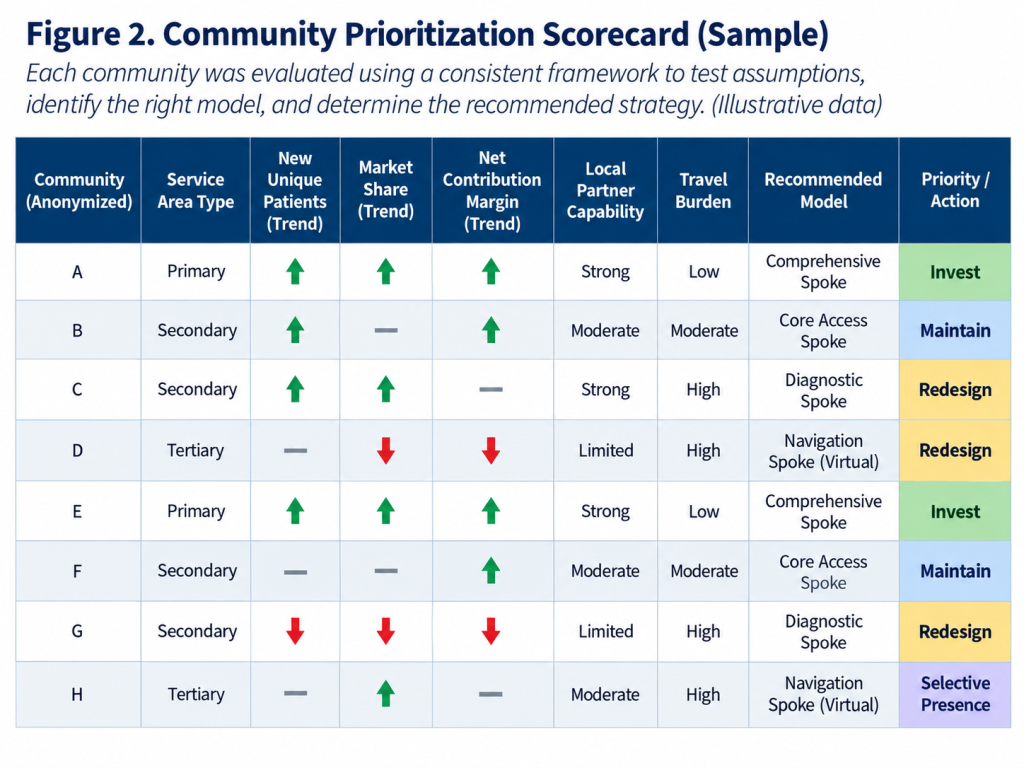
Importantly, those economics were not used simply to label communities profitable or unprofitable. They helped test and refine the clinical model. In some communities, the data supported continued or expanded physician presence. In others, the better model was a different combination of local diagnostics, APP support, virtual care, targeted specialist presence, and clearly defined triggers for escalation to the hub. The relevant question became less about whether to retain an outreach clinic and more about what combination of resources created the most clinically appropriate and financially sustainable pathway for that particular community.
The capstone also produced proof points around the importance of local capability and partnership structure. Not every spoke required the same model. Differences in patient demand, geography, travel burden, primary care capacity, diagnostic resources, and local partners materially changed what could appropriately remain in the community. The results led to restructuring aspects of local partnerships and strengthening clinical pathways within individual markets. Those changes, in turn, allowed regional access to be designed more precisely: what should remain local, what could be enabled through a community partner, what required regional specialty capability, and what should return to the community following higher-acuity care.
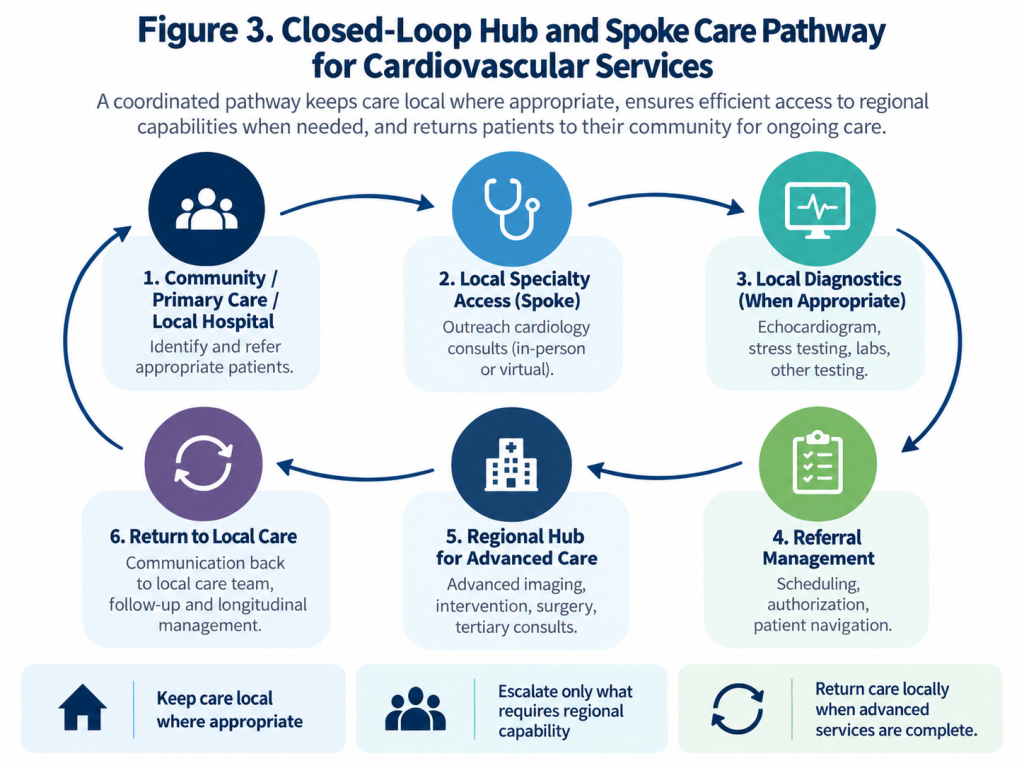
That final element became critical to the regional model. A functioning hub-and-spoke network could not operate as a one-way referral funnel. The intended pathway was local care, specialty access close to home, regional care when clinically necessary, advanced services when required, and then intentional return to local care. That required referral intake, prioritization, scheduling, authorization, patient navigation, referral completion, communication back to the local care team, and repatriation to be treated as parts of the clinical model rather than administrative processes around it.
Applying the framework across more than three dozen communities also changed how specialist capacity could be viewed. Specialist time became a regional asset. The more useful question was not simply how many wRVUs were produced during an outreach day, but what that specialist day created across the network: new patients reached, care appropriately maintained locally, downstream pathways supported, avoidable leakage reduced, and net contribution generated relative to the full cost and opportunity cost of providing the service.
The value of Philip’s Baldrige capstone was therefore not a single conclusion or ranking of outreach markets. It provided a disciplined systems approach for testing assumptions, producing evidence across a large number of individualized communities, and using those proof points to change the operating model. The result was a more precise rural specialty strategy: keep care local where clinically appropriate, strengthen community capabilities and partnerships where possible, create reliable pathways to regional resources where necessary, return patients locally when advanced care is complete, and continually use clinical, access, and financial results to determine how the model should evolve.