During the first half of 2026, UnitedHealth Group continued to stabilize following the medical cost and operational challenges that pressured 2025 results. Medical cost management, pricing, and benefit-design actions improved UnitedHealthcare profitability, while Optum moved from weaker year-over-year operating earnings in Q1 to stronger performance in Q2. Management raised full-year adjusted earnings guidance after both quarters. This report reviews UnitedHealth Group’s Q1 and Q2 2026 performance and outlook through the lens of Pinnacle Healthcare Consulting.
Key First Half 2026 Financial Metrics
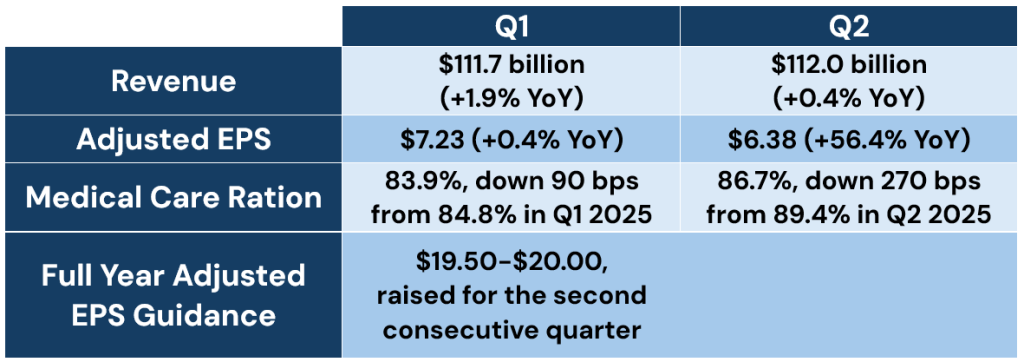
UnitedHealth Group’s results reflected a meaningful recovery in profitability despite limited top-line growth. Revenue increased modestly YoY in both quarters, while the medical care ratio (MCR) improved materially versus 2025 as pricing discipline, benefit design, medical management, and favorable reserve development offset persistently elevated utilization and unit cost trends. The sequential guidance increases indicate improving confidence in the earnings recovery, although membership attrition and continued investment in technology, operations, and consumer experience remain important considerations.
Segment & Service Line Performance
UnitedHealth Group’s first half results show improving performance across UnitedHealthcare and a more uneven but strengthening trajectory at Optum. Pinnacle views the sharp YoY improvement in UnitedHealthcare’s medical cost performance and the Q2 rebound in Optum operating earnings as the most important developments, alongside continued simplification of the portfolio and operating model.
UnitedHealthcare: Pricing discipline, benefit design changes and medical cost management drove improved margins. Q1 operating earnings increased to $5.7 billion from $5.2 billion and margin expanded to 6.6% from 6.2%; Q2 operating earnings increased to $3.9 billion from $2.1 billion and margin improved to 4.6% from 2.4%. These gains were achieved despite membership attrition, including approximately 965,000 fewer Medicare Advantage members since year end 2025, which remains an important revenue and risk-pool consideration.
Optum: Performance improved materially in Q2 after a softer Q1. Total Optum Q2 operating earnings reached approximately $4.0 billion versus $3.1 billion in Q2 2025, with operating margin expanding by roughly 160 basis points year over year. Optum Health generated $1.2 billion of Q2 operating earnings at a 5.1% margin despite serving approximately 700,000 fewer value-based care patients, while Optum Insight, and Optum Rx also posted YoY earnings growth. The results point to improving care delivery economics and operating execution rather than volume led growth.
Technology & Portfolio Strategy: UnitedHealth continued to emphasize AI-enabled automation, digital prior authorization, and pharmacy transparency while simplifying its portfolio. The company announced the Alegeus Technologies acquisition in Q1 and Optum Financial closed the transaction on July 2, shortly after quarter end, adding HSA, FSA, HRA, COBRA, and related consumer directed benefit account capabilities. UnitedHealth also completed the sale of Optum UK in Q1. In Pinnacle’s view, these actions support a more focused strategy built around U.S. healthcare, technology enabled efficiency, and consumer directed healthcare rather than broad international expansion.
Full Year Outlook
UnitedHealth raised FY 2026 adjusted earnings guidance to $19.50-$20.00 per share from greater than $18.25 after Q1 and greater than $17.75 at the start of the year. Management now expects approximately $24 billion operating cash flow, at least $5 billion of share repurchases, and a full year MCR of 88.1% plus or minus 25 basis points. The updated outlook also calls for more than $25.45 billion of consolidated operating earnings and more than $16.75 billion of net earnings attributable to UnitedHealth Group shareholders.
Pinnacle’s Outlook
Pinnacle views the guidance increase as evidence that the earnings recovery is progressing faster than the company’s January expectations. The key second half questions are whether MCR improvement can be sustained as favorable reserve development normalizes, whether pricing and benefit actions remain adequate against utilization and specialty drug cost trends, and whether Optum can maintain Q2’s operating momentum despite lower value-based care and UnitedHealthcare membership. Continued execution would position UnitedHealth to enter 2027 with a stronger earnings base, but the quality of the recovery will depend on durable medical cost performance rather than reserve development alone.