Surgery Partners (NASDAQ: SGRY) continued to demonstrate steady growth across its ambulatory surgery center (“ASC”) platform during the first half of 2026, supported by favorable reimbursement trends, increasing procedural complexity, and the continued migration of surgical procedures to outpatient settings. While case volume growth remained modest through both quarters, increases in revenue per case helped drive same-facility revenue growth. Throughout the first half of the year, management remained focused on physician recruitment, higher-acuity procedures, selective acquisitions, and de novo development, while maintaining a disciplined approach to capital deployment. Surgery Partners also reaffirmed its full-year 2026 financial guidance following both quarters. This report reviews Q1 and Q2 2026 performance and outlooks through the lens of Pinnacle Healthcare Consulting.
Key First Half 2026 Financial Metrics
Surgery Partners reported steady revenue growth through the first half of 2026, with same-facility revenue growth remaining above 4% in both quarters. While same-facility case volume growth was modest, increases in revenue per case supported overall performance.
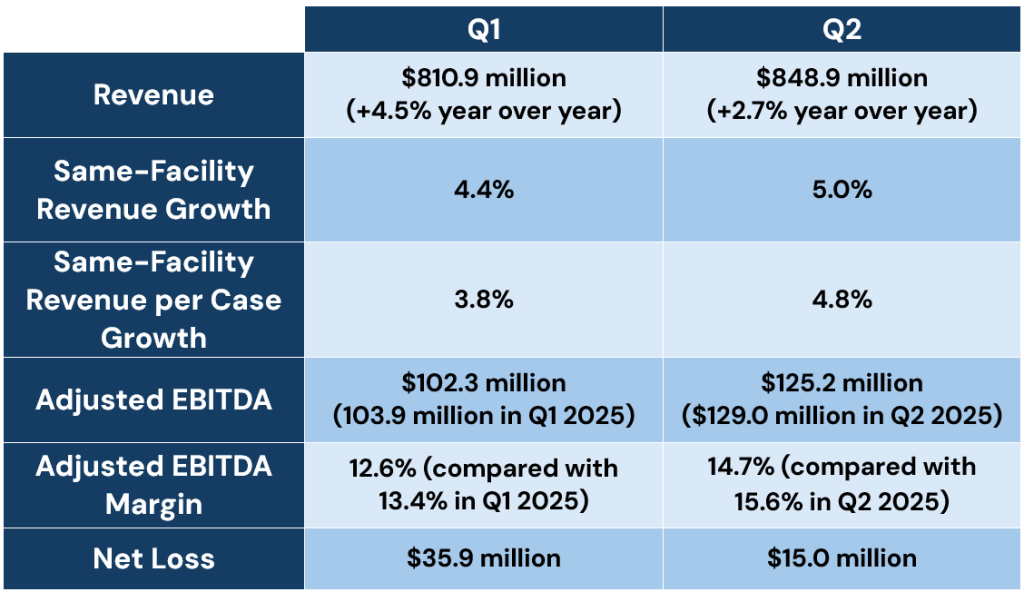
The results across both quarters demonstrate a consistent trend in Surgery Partners’ operating performance. Same-facility case volume increased only modestly, at 0.6% in Q1 and 0.3% in Q2, while revenue per case increased 3.8% and 4.8%, respectively. As a result, first-half growth was driven more significantly by reimbursement trends and increasing procedural complexity than by overall case volume expansion.
Segment & Service Line Performance
Higher-Acuity Procedures: remained a key growth driver for Surgery Partners during the first half of 2026. The company benefited from favorable reimbursement trends and increasing procedural complexity, which helped boost revenue growth even as case volumes grew modestly. In Q1, same-facility revenue per case increased 3.8% compared with case volume growth of 0.6%, while Q2 showed a similar pattern with revenue per case rising 4.8% versus volume growth of 0.3%. These results highlight Surgery Partners’ ability to generate organic growth by performing more complex, higher-value procedures within its ASC network. Longer term, the ongoing shift of surgical procedures from hospitals to lower-cost outpatient settings continues to support the company’s growth strategy.
Physician Recruitment and Strategic Portfolio Expansion: remained important priorities throughout the first half of 2026. Surgery Partners continued to focus on physician alignment, selective acquisitions, and de novo facility development as drivers of future growth. Rather than pursuing large-scale transactions, management emphasized targeted investments designed to expand capacity and increase utilization across its existing network. This approach reflects the critical role physicians play in the ASC model, as strong physician partnerships can support both higher procedure volumes and a broader mix of complex procedures that contribute to long-term revenue growth.
Idaho Falls Divestiture Advances Portfolio Optimization: One of the most significant strategic developments in Q2 was the announced sale of Surgery Partners’ Idaho Falls operations to Intermountain Health for approximately $795 million in expected proceeds. The transaction is intended to strengthen the company’s balance sheet, improve cash conversion, reduce leverage, and further sharpen its focus on outpatient surgical services. Upon completion, more than 95% of Surgery Partners’ operations are expected to consist of outpatient and short-stay surgical services. Management views the divestiture as an important step in its portfolio optimization strategy and a way to support future investment in physician recruitment, facility development, and targeted acquisitions.
Expense Pressures Remain an Area to Watch: Despite continued revenue growth, profitability remained pressured during the first half of 2026. Adjusted EBITDA declined modestly year over year in both Q1 and Q2, while Q1 adjusted EBITDA margin fell to 12.6% from 13.4% in the prior-year period. The results underscore ongoing challenges related to labor, medical supplies, and other operating costs. As Surgery Partners continues to expand its mix of higher-acuity procedures, effective cost management will remain critical. Management has identified expense discipline and operational improvement initiatives as key priorities for the remainder of the year as it seeks to convert revenue growth into stronger margin performance.
Full Year Outlook
Surgery Partners reaffirmed its full-year 2026 guidance following both Q1 and Q2, maintaining expected revenue of $3.35 billion to $3.45 billion and Adjusted EBITDA of at least $530 million. During the first half of the year, the company continued to benefit from the migration of higher-acuity procedures into outpatient settings, strong same-facility revenue growth, ongoing physician recruitment efforts, and disciplined portfolio management. The announced Idaho Falls divestiture further supports Surgery Partners’ strategy of sharpening its focus on core outpatient surgical services while improving financial flexibility and reducing leverage. Despite continued operating expense pressures, management remains optimistic that higher-value procedures, physician alignment, and targeted growth investments will support performance through the remainder of 2026.
Pinnacle’s Outlook
Surgery Partners’ first-half results highlight the continued strength of the ambulatory surgery center model and the healthcare industry’s ongoing shift toward outpatient care. The company’s focus on higher-acuity procedures, physician partnerships, disciplined capital allocation, and portfolio optimization positions to benefit from these long-term market trends. While reimbursement dynamics and operating expenses remain important areas to monitor, Surgery Partners appears well positioned to capitalize on continued procedure migration from hospitals to ASCs and drive sustainable growth through the remainder of 2026.