Article originally published through the American Association of Provider Compensation Professionals (AAPCP).
Opening Remarks
Today’s rural hospital leaders face the unique challenge of sustaining access to essential services while simultaneously maintaining financial viability in an increasingly fragile operating environment. In recognition of this undertaking, Congress created the Rural Emergency Hospital (REH) designation as a strategic option for rural facilities. Effective as of January 1, 2023, the REH designation aims to offer a path for preserving 24/7 emergency and outpatient care in rural settings without the burden of full acute inpatient operations which likely entail persistently low inpatient volumes, workforce constraints, and mounting reimbursement pressure. While the REH model introduces new opportunities for financial predictability and operational focus, it also raises questions for facility leadership concerning long-term sustainability, staffing models, and the evolution of provider compensation to align with a new care delivery model which is centered on coverage and access rather than inpatient volume. The following sections discuss an overview of the REH program as well as associated key considerations and implications in the ever-evolving healthcare landscape.
Overview of the REH Program
The REH designation denotes a Medicare provider type that allows eligible rural hospitals to maintain emergency and outpatient services without offering acute inpatient care. Established under the Consolidated Appropriations Act of 2021, the REH is the first new Medicare provider type created since the Critical Access Hospital (CAH) designation in 1997. [1][2][3]
The REH designation was created in response to sustained financial pressure on rural hospitals which threatens patient access to necessary health services. In fact, since 2010, more than 140 rural hospitals have closed and hundreds more remain at risk of closing, with more than half of all rural hospitals operating at a financial loss. [1][9] The human cost of these pressures is undeniable. For instance, Sturgis Hospital in Michigan served its community for 101 years before announcing its closure in 2026 — even after converting to REH status in an effort to stay open. [6] The REH model offers a strategic option for eligible facilities in which full inpatient operations may no longer be financially sustainable. While this designation offers many benefits in rural communities, the REH does not guarantee a financial viability or resolution of the deeper structural challenges (workforce shortages, inadequate reimbursement, and declining inpatient demand) that strain the traditional full-service rural hospital model. [1]
Eligibility
To convert to a REH designation, a facility must be a designated Critical Access Hospital (CAH) or a rural hospital with no more than 50 beds and enrolled or certified in Medicare as of December 27, 2020. Indian Health Service hospitals that meet the bed criteria are also eligible for conversion. Additionally, facilities must hold a transfer agreement with a Level I or II trauma center and otherwise meet the REH Conditions of Participation. [1][2][17]
Core Operational Requirements
As a qualified REH, facilities must maintain laboratory, diagnostic radiology, pharmacy or drug-storage, registered-nurse-supervised discharge planning, and provide 24/7 emergency services with qualified clinician availability. Specifically, a provider must be onsite or on-call and available onsite within required timeframes and the average patient length of stay may not exceed 24 hours. [2][10][17]
REHs may provide a range of outpatient services (e.g., behavioral health, radiology, laboratory, and outpatient rehabilitation) but cannot provide acute inpatient services, excepting only a distinct-part skilled nursing facility (SNF) unit. Notably, this stipulation is not equivalent to the flexible CAH swing-bed arrangement – which facilities must give up on conversion to a REH. A distinct-part SNF must be separately licensed, serves only SNF-level patients, and is reimbursed under the SNF Prospective Payment System rather than cost-based rates. Because such a unit still has overnight patients, it continues to require nursing staff and provider oversight — a point with direct implications for staffing cost and compensation planning. [2][3]
Payment and Financial Structure
In order to meet its objectives, the REH model combines enhanced per-service reimbursement with a fixed monthly facility payment. REH-covered services are paid at 105% of the Outpatient Prospective Payment System (OPPS) rate — the standard rate plus a 5% add-on — while services that are not REH-covered services are paid under the applicable fee schedule with no add-on. [1][4][16] For calendar year 2026, the fixed monthly facility payment is approximately $300,000, or roughly $3.6 million annually. These monthly payments are identical across facilities, independent of patient volume, and updated each year by the hospital market basket. [15]
Importantly, the monthly payment is not purely additive. Converting facilities also give up CAH-specific advantages — the 340B drug discount program, the Method II physician billing option, and enhanced ambulance reimbursement — making the financial effect variable. To help offset the loss of inpatient revenue, many REHs make active use of a distinct-part SNF unit, which has become one of the more meaningful revenue sources for converted facilities working to establish stable footing under the new model. [2][4]
Current Landscape and Adoption
Since the designation took effect, adoption has been gradual. As of May 2026, 51 hospitals across 21 states had converted to REH status. [6][7] Converted facilities are concentrated in the Midwest and South — regions with high densities of rural hospitals and elevated closure risk — and most sit in non-metro counties frequently designated as Health Professional Shortage Areas (HPSAs) or Medically Underserved Areas (MUAs). Consistent among early adopters are low inpatient census (often fewer than five inpatients per day) alongside heavy reliance on emergency and outpatient services prior to conversion, facts which are consistent with a decade-long decline in rural inpatient utilization. [9][19]
Figure 1. Geographic distribution of current Rural Emergency Hospitals. Source: CMS / Sheps Center. [6][7][14]
Early adopters tend to share several characteristics: (i) low inpatient volumes below sustainable thresholds for 24/7 inpatient units, (ii) financial distress (i.e., consistent with national analyses indicating that more than half of rural hospitals operate at a loss), (iii) small bed size (typically CAHs of 25 beds or fewer, or rural hospitals of 50 beds or fewer), and (iv) geographic isolation, with limited local alternatives and significant travel distances to the nearest full-service hospital. [1][9][19]
Despite the benefits of attaining the REH designation, the eligible market is far larger than current adoption suggests. While estimates vary, more than 1,000 rural hospitals meet the statutory criteria and some analyses project that several hundred could eventually convert if financial pressure intensifies. With 51 conversions to date, fewer than 5% of eligible hospitals have transitioned — a gap that reflects both operational hurdles and uncertainty about long-term sustainability. [11][12]
Hospitals that convert commonly cite financial instability, persistently low inpatient demand, the appeal of a predictable monthly payment, and the desire to avoid outright closure. Those that decline commonly cite the loss of inpatient services (and the community perception of a downgrade), regulatory and licensure complexity, uncertainty about long-term viability, workforce constraints in maintaining 24/7 coverage, and increased dependence on transfer partners. [8][9]
Implications for Provider Compensation
Because REHs no longer provide inpatient services, many such facilities are moving away from traditional provider compensation models. In their place, REHs are generally compensating clinicians based on availability structured around emergency-department shifts, on-call or standby pay, per-shift stipends, and combined ED and outpatient roles which are often supported by telehealth. Put simply, providers are paid to keep services open and accessible rather than to generate a high volume of visits. [13]
This shift in philosophy carries real implications for provider compensation professionals, including compliance offers and valuators. Specifically, where compensation is tied to availability rather than measurable productivity, modification to the determination and documentation of fair market value (FMV) is likely previously used productivity-based benchmark surveys and may not map cleanly to coverage-based arrangements. Because REHs often have low ED volumes, compensation must be carefully aligned with FMV, commercial reasonableness, and regulatory expectations for low-volume settings. [13] Government enforcement interest in rural physician compensation has also increased: rural facilities that pay above FMV to recruit and retain providers — often a practical necessity given market conditions — face heightened Stark Law and Anti-Kickback exposure. The practical consequence is that provider compensation assessment in the REH setting demands more rigor rather than less, including disciplined documentation, defensible FMV support, and clear commercial-reasonableness analysis.
Benefits and Challenges
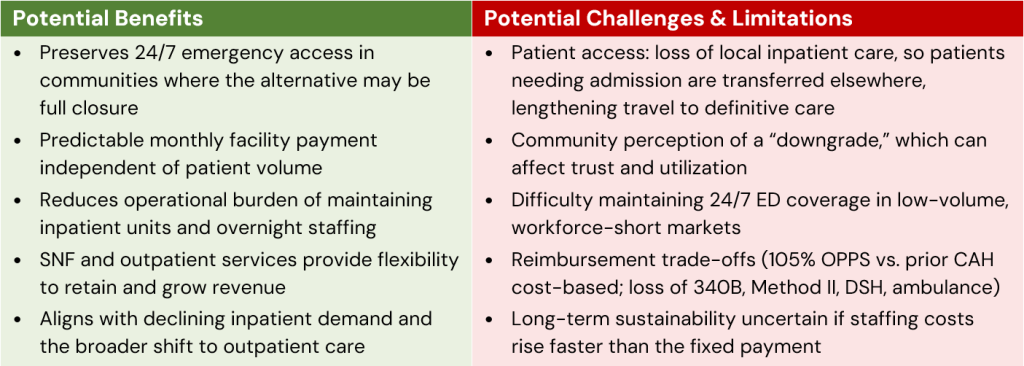
The sections below consider the potential benefits and challenges of the REH model — not a verdict on whether any one hospital should convert. As with most decisions in rural healthcare, the right path depends on the individual facility and the community it serves. [1][3] While these benefits and challenges are discussed in greater detail in the following sub-sections, the following table provides a summary of key considerations.
Potential Benefits
The most notable and direct benefit of the REH designation is the preservation of 24/7 emergency care in communities whose alternative may be full closure (i.e., which lengthens travel time to the nearest emergency department (ED) and erodes local access to emergency-sensitive care). [5][6] The fixed monthly payment introduces a more predictable revenue component and reduces the burden of maintaining inpatient services, although the net effect depends on a facility’s prior inpatient volume, payer mix, CAH reimbursement position, and retained services. Hospitals that converted generally had low pre-conversion inpatient volume, occupancy, and revenue. Likewise, analyses of likely converters found a median acute daily census of fewer than one to two inpatients per day among the lowest-volume eligible hospitals — facilities that transferred far more patients than they admitted locally. [9][12] Notably, some early analyses suggest the model may be one factor associated with a slower pace of rural closures, though the longer-term impact is still developing. [8]
In addition to mitigating rural facility closures, REH conversion can also simplify staffing by removing full-capacity overnight hospitalist coverage and inpatient nursing. This fact may, in turn, ease workforce strain at facilities already short on providers. Similarly, a distinct-part SNF unit can provide a meaningful retained revenue stream for post-hospital extended care. However, it should be noted that because it is reimbursed under SNF PPS rather than the REH’s 105% OPPS rate, SNF revenue must be tracked under a separate payment framework. Accordingly, any compensation for physicians or advanced practice providers (APPs) providing oversight of SNF patients carries its own distinct FMV considerations for provider-oversight roles. [2][9]
Challenges and Limitations
Workforce stability remains one of the most significant operational challenges for REHs. Rural communities already face longstanding provider shortages (including physicians, nurses, and APPs) and the REH model often places additional pressure on these limited labor pools. In particular, given the structure of the REH designation, these facilities must maintain round-the-clock ED coverage, onsite staffing, rapid transfer coordination, and adequate outpatient staffing. While CMS does not set a fixed nurse-to-patient ratio for REHs, its Conditions of Participation establish several baseline staffing requirements. A registered nurse, clinical nurse specialist, or licensed practical nurse must be on duty whenever an REH has one or more patients receiving emergency or observation care. A physician, nurse practitioner, clinical nurse specialist, or physician assistant must also be immediately available to provide emergency services. In addition, a clinician trained or experienced in emergency care must always be on call and able to be onsite within 30 minutes (or 60 minutes in frontier areas). [17] Meeting these requirements can be difficult in low-volume rural settings. Many REHs rely heavily on APPs, locum tenens clinicians, and contracted emergency medicine groups to maintain coverage. As staffing costs for emergency coverage continue to rise, REHs may face tension between the fixed monthly facility payment and the high fixed cost of maintaining 24/7 coverage and clinician readiness. [9]
In addition to workforce considerations, community response can also be mixed. Although REH conversion preserves local emergency and outpatient access, some residents may view the loss of inpatient and specialty services as a reduction in the hospital’s capabilities. A 2026 study published in the Journal of Rural Health found that some rural residents expressed skepticism about the quality of care available after REH conversion and, in some cases, preferred to seek care elsewhere even when local services remained available. Concerns included longer travel distances, potential delays related to transfers, and reliance on referral relationships for more advanced care. [9] These considerations align with Pinnacle’s experience and those echoed in executive roundtable discussions and conversations with hospital administrators. While the REH model helps maintain access to essential services, the loss of local inpatient and specialty care may nevertheless entice patients to urban centers for treatment. This fact can create both clinical and economic consequences for rural communities, as healthcare dollars and patient activity shift outside the local market. [20] Ultimately, the long-term sustainability of the REH model depends on several factors, including workforce availability, staffing costs, community acceptance, strong transfer partnerships, and the ability to diversify outpatient services. REHs may remain financially vulnerable if staffing costs continue to outpace the fixed monthly facility payment. [8]
A concrete example of this risk involves Sturgis Hospital in Michigan. In that case, Sturgis converted to REH status in an effort to preserve services and stabilize its finances. However, despite the REH conversion and additional funding, the hospital announced in 2026 that it would close — ending 101 years of service to its community. The closure of Sturgis was the fourth hospital closure of 2026, following 23 closures in 2025 and 25 in 2024. [6]
Despite said closures, Sturgis and other similar stories does not diminish the value of the REH model. For many facilities, conversion has meaningfully extended their ability to serve their communities. However, these facility closures do underscore that conversion is not a guarantee of survival. When underlying financial pressures such as staffing costs, low volume, and inadequate reimbursement are severe enough, even a redesigned model and additional federal support may not be sufficient to keep a facility open.
Conclusion
While the REH model is not a universal solution, it creates a legitimate alternative structure for eligible rural hospitals facing unsustainable inpatient operations. The REH designation helps communities preserve access to emergency and outpatient care; however, it does not per se reverse the broader structural pressures driving rural hospital instability. For provider compensation professionals, the shift from volume-based inpatient productivity models toward coverage, availability, and outpatient-based models requires more – not less – discipline. Specifically, these facilities require clearer documentation, more rigorous FMV support, and arrangements built around identifiable services and defensible commercial reasonableness — especially as government scrutiny in the rural space increases.
In addition, the issue of adequate provider staffing does not disappear at conversion. The manner in which REHs continue to recruit, retain, and fairly compensate the clinicians needed to sustain 24/7 emergency and outpatient services — in markets where provider supply is already thin — is the central operational and compensation challenge going forward. REH conversion changes operational and compensation models but it does not solve the provider workforce shortage.
There are reasons for optimism about the future of rural healthcare: (i) regional collaborations are forming, (ii) specialty-hub arrangements are emerging, and (iii) the recent significant federal investments in rural healthcare. The leaders closest to these communities have shown consistent resolve in adapting and executing locally. If compensation arrangements are built with the same discipline and intentionality, they can support rather than undermine that progress.
References
- Rural Health Information Hub. Rural Emergency Hospitals (REHs) Overview. https://www.ruralhealthinfo.org/topics/rural-emergency-hospitals
- Centers for Medicare & Medicaid Services. Rural Emergency Hospitals. https://www.cms.gov/medicare/health-safety-standards/certification-compliance/rural-emergency-hospitals
- Rural Health Redesign Center / Mathematica. REH Model Frequently Asked Questions, April 2025. https://rhrco.org/wp-content/uploads/2024/08/REHFAQApril2025.pdf
- PYA. Medicare Reimbursement for Rural Providers (CAHs, REHs, RHCs, SCHs, and More). https://www.pyapc.com/insights/
- Chartis Center for Rural Health. 2026 Rural Health State of the State. https://www.chartis.com/insights/2026-rural-health-state-state
- Becker’s Hospital Review. The Rural Emergency Hospitals, by State (May 2026). https://www.beckershospitalreview.com/rural-health/
- UNC Cecil G. Sheps Center for Health Services Research. Rural Emergency Hospitals tracker. https://www.shepscenter.unc.edu/programs-projects/rural-health/rural-emergency-hospitals/
- Bipartisan Policy Center. The Rural Emergency Hospital Model: Year Two Progress Report (2024). https://bipartisanpolicy.org/
- Rural Emergency Hospitals: Emerging Patterns of Adaptation and Community Perception. NLM / PMC. https://www.ncbi.nlm.nih.gov/pmc/articles/PMC12811699/
- National Academy for State Health Policy. Medicare’s New REH Designation — Considerations for States. https://nashp.org/
- KFF. 10 Things to Know About Rural Hospitals. https://www.kff.org/health-costs/issue-brief/10-things-to-know-about-rural-hospitals/
- JAMA Health Forum. Characteristics of Hospitals Eligible for Rural Emergency Hospital Designation. https://www.ncbi.nlm.nih.gov/pmc/articles/PMC9856250/
- Stroudwater Associates. Rural Physician Compensation Case Study (practical comp/FMV discussion). https://www.stroudwater.com/case-study/
- CMS Provider Data Catalog — Hospital General Information dataset (live REH count / locations). https://data.cms.gov/provider-data/
- CMS Change Request 14334 / Transmittal 13536 — CY2026 REH Monthly Facility Payment. https://www.cms.gov/files/document/r13536cp.pdf
- eCFR. 42 CFR Part 419, Subpart J — REH payment rules. https://www.ecfr.gov/current/title-42/chapter-IV/subchapter-B/part-419/subpart-J
- eCFR. 42 CFR Part 485, Subpart E — REH Conditions of Participation. https://www.ecfr.gov/current/title-42/chapter-IV/subchapter-G/part- 485/subpart-E
- Center for Healthcare Quality and Payment Reform (CHQPR). Rural Hospitals at Risk of Closing (January 2026). https://chqpr.org/downloads/Rural_Hospitals_at_Risk_of_Closing.pdf
- Health Affairs Scholar. Characterizing Early Adopters of the Rural Emergency Hospital Designation. https://academic.oup.com/haschol/
- JAMA Network Open. Early Evaluation of the Rural Emergency Hospital Program. https://jamanetwork.com/journals/jamanetworkopen/
- Pinnacle Healthcare Consulting. Internal perspective: executive roundtable conversations and hospital administrator interviews on REH community impact, 2025–2026.