RadNet (NASDAQ: RDNT) delivered strong financial and operational performance during the first half of 2026, reporting record revenue in both the first and second quarters. Growth was supported by increasing demand for advanced imaging services, continued expansion of the company’s Digital Health platform, strategic acquisitions, and investments in imaging capacity and technology. The company’s first-half performance was particularly notable given severe winter weather disruptions during Q1 that affected several key markets. Following a strong rebound in March, momentum continued into Q2, with increasing advanced imaging volumes and rapid Digital Health growth contributing to another record quarter. Management raised its 2026 financial guidance following both quarters, reflecting continued confidence in underlying demand and operating performance. This report reviews Q1 and Q2 2026 performance and outlooks through the lens of Pinnacle Healthcare Consulting.
Key First Half 2026 Financial Metrics
RadNet reported strong year-over-year increases in both revenue and Adjusted EBITDA during the first half of 2026, while its Digital Health segment continued to expand at a significantly faster rate. The following table provides a side-by-side comparison of key first-half and second-quarter financial metrics.
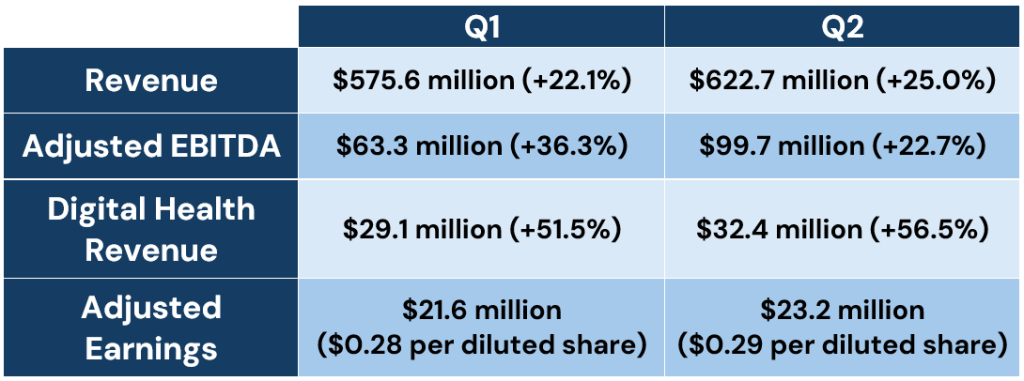
Together, Q1 and Q2 demonstrate accelerating demand across RadNet’s imaging platform. Advanced imaging volumes grew substantially faster than overall procedural volumes, while Digital Health revenue increased by more than 50% in each quarter. The results reflect a continued shift toward higher-value imaging services alongside growing adoption of RadNet’s AI-enabled technology offerings.
Segment & Service Line Performance
Advanced Imaging Growth: Advanced imaging remained a key contributor to RadNet’s growth during the first half of 2026. Aggregate MRI, CT, and PET/CT volumes increased 19.7% year over year during Q1 and accelerated to 21.2% during Q2. Same-center advanced imaging volumes increased 8.2% and 9.6%, respectively. In Q1, advanced imaging represented 29.3% of total procedural volume, compared with 26.9% during the prior-year quarter, demonstrating an ongoing shift toward higher-value and more clinically complex imaging services.
MRI and CT: RadNet continued investing in imaging capacity during the first half of the year through equipment upgrades, expanded operating hours, and technology-enabled workflow improvements. These initiatives helped the company accommodate growing patient demand while improving utilization of its existing imaging infrastructure. MRI and CT volumes remained strong, with Q1 aggregate volumes increasing 20.3% and 17.7%, respectively. Same-center MRI volume increased 10.0%, while same-center CT volume increased 4.7%. Momentum in advanced imaging continued into Q2 as investments in capacity and operating efficiencies supported further growth.
PET/CT: Advanced imaging remained a key growth driver for RadNet, with PET/CT demand benefiting from expanding clinical applications in prostate cancer and neurological care. During Q1, aggregate PET/CT volume increased 35.2%, while same-center volume grew 14.7%. Growth in MRI, CT, and PET/CT continues to support a favorable procedure mix, positioning the company to increase volume and revenue without relying solely on new imaging center development.
Digital Health and AI Expansion: Digital Health remained one of RadNet’s fastest-growing businesses during the first half of 2026, with revenue increasing more than 50% in both Q1 and Q2 and ARR surpassing $105 million by the end of the second quarter. The company continued expanding its AI-enabled imaging platform, investing in infrastructure, product development, and commercialization efforts to support future growth. While these investments weighed on near-term profitability, RadNet views Digital Health as a significant long-term opportunity to improve imaging workflows, drive recurring revenue, and extend its reach beyond its owned imaging center network.
Acquisitions and Health System Partnerships
Strategic acquisitions and health system partnerships remained key components of RadNet’s growth strategy during the first half of 2026. The company expanded its imaging footprint through acquisitions in Florida and Indiana while also strengthening its Digital Health capabilities through the acquisition of AI imaging company Gleamer. RadNet further advanced its outpatient imaging strategy through a new joint venture with Trinity Health’s Saint Alphonsus Health System, reflecting its continued focus on partnerships that expand market access and referral networks. Supported by a strong balance sheet, including approximately $726 million in cash and net leverage of about 1.8x at the end of Q2, RadNet remains well positioned to pursue additional acquisitions, technology investments, and organic growth opportunities.
Full-Year Outlook
Following a strong first half of 2026, RadNet raised its Imaging Center segment guidance while continuing to invest in the growth of its Digital Health business. Management cited strong advanced imaging demand, favorable procedure mix trends, expanded capacity, and contributions from recent acquisitions as key drivers of performance. At the same time, continued growth in AI-enabled imaging solutions and recurring Digital Health revenue remains an important part of the company’s long-term strategy.
Pinnacle’s Outlook
RadNet’s first-half results reinforce several key trends shaping the diagnostic imaging market, including growing demand for advanced imaging, increasing adoption of AI-driven workflow tools, and expanding collaboration between imaging providers and health systems. The company’s investments in Digital Health, strategic acquisitions, and outpatient imaging capacity position it well for continued growth. Looking ahead, key areas to monitor include same-center imaging volume growth, integration of recent acquisitions, commercialization of AI solutions, and the company’s ability to translate Digital Health momentum into sustainable profitability.