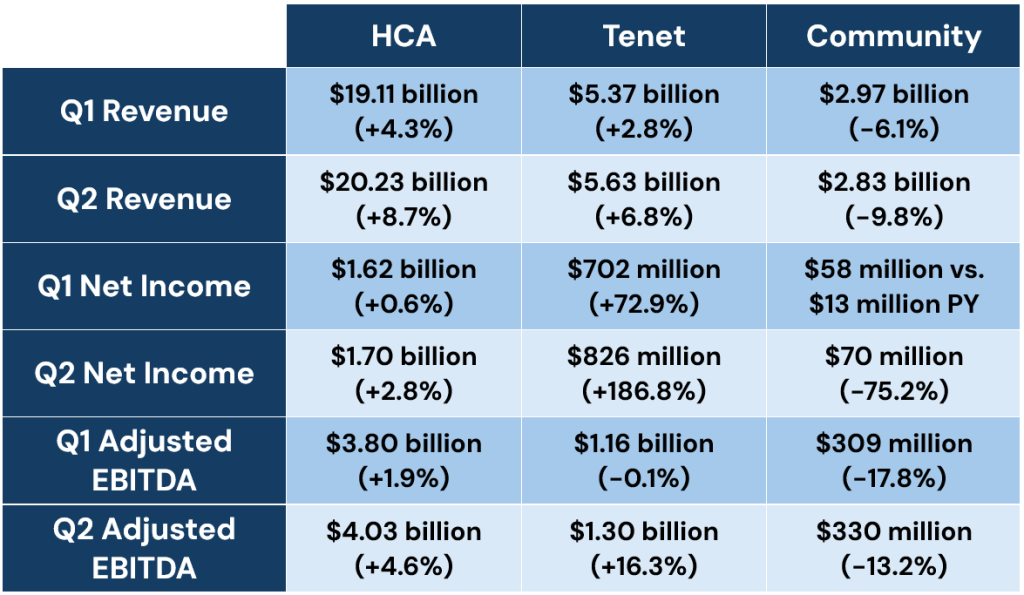
During the first half of 2026, major for profit hospital operators navigated lower Affordable Care Act (ACA) exchange enrollment, payer mix deterioration, uneven surgical volumes, and significant state Medicaid supplemental and directed-payment activity. HCA Healthcare generated YoY revenue and Adjusted EBITDA growth in both quarters, although its Adjusted EBITDA margin remained below prior-year levels. Tenet Healthcare’s operating momentum strengthened materially in Q2, while Community Health Systems (CHS) continued to face consolidated revenue and earnings pressure from divestitures and unfavorable payer mix. This report reviews Q1 and Q2 2026 performance and outlooks through the lens of Pinnacle Healthcare Consulting.
Key First Half 2026 Financial Metrics
HCA Healthcare, Tenet Healthcare, and Community Health Systems enter the second half of the year with increasingly divergent operating trajectories. HCA posted 4.3% and 8.7% YoY revenue growth in Q1 and Q2, respectively, with Adjusted EBITDA growth of 1.9% and 4.6%. Tenet’s consolidated Adjusted EBITDA was essentially flat in Q1 before increasing 16.3% in Q2, with Q2 margin expanding to 23.2%. CHS reported lower consolidated revenue and Adjusted EBITDA in both quarters, even as Q2 same-store revenue and adjusted admissions improved. The table below compares each quarter with the corresponding prior-year period. For Tenet, net operating revenue excludes contract-termination revenue, while GAAP net income includes the effect of $413 million of contract-termination revenue recognized in Q1 2026 in connection with the early conclusion of the CommonSpirit contract; Adjusted EBITDA excludes this item.
Segment & Service Line Performance
First half performance was shaped by same facility volume trends, payer and service mix, reimbursement timing, and the continued migration of higher acuity care to outpatient settings. HCA and Tenet benefited from underlying demand and expense discipline, while CHS’s consolidated results remained heavily influenced by hospital divestitures and payer mix pressure.
HCA Healthcare generated positive revenue and Adjusted EBITDA growth in both quarters, but Q2 results also reflected unusually large reimbursement and payer mix effects. Same facility admissions accelerated, surgical volumes remained pressured, and lower exchange coverage increased uninsured volume. At the same time, Florida’s Medicaid directed payment approval produced significant catch-up revenue and expense.
- Same facility admissions increased 0.9% in Q1 and 2.5% in Q2; equivalent admissions increased 1.3% and 2.7%, respectively.
- Same facility emergency room visits increased 0.3% in Q1 and 3.6% in Q2; Q2 inpatient and outpatient surgeries declined 2.3% and 3.4%, respectively.
- Exchange driven payer mix deterioration reduced Q2 pretax income by approximately $400 million, while Medicaid supplemental payment programs provided an approximately $400 million incremental net benefit, primarily from Florida.
Pinnacle believes HCA’s first half results demonstrate volume resilience, but reported Q2 growth requires careful separation of core operations from reimbursement timing. Q2 included $1.372 billion of Florida directed payment revenue and $829 million of related operating expense for October 2024 through June 2026, with a majority attributable to periods before 2026. Key watch items are uninsured payer mix, surgical volumes, and the sustainability of same facility revenue growth.
Tenet delivered strengthening operating performance from Q1 to Q2. Consolidated Adjusted EBITDA was essentially flat year over year in Q1 before increasing 16.3% in Q2, driven by hospital margin expansion and continued growth at USPI. Ambulatory performance was supported more by higher acuity and revenue per case than by broad case growth.
- Hospital net operating revenue increased 6.0% in Q2, while same hospital adjusted admissions grew 2.6%.
- Hospital Adjusted EBITDA increased 22.3% to $762 million, expanding margin to 18.0% from 15.6% in Q2 2025.
- Ambulatory Care Adjusted EBITDA reached $542 million (+8.8%); same facility surgical cases declined 1.2%, while net revenue per case increased 6.3% on higher acuity and favorable service mix.
Pinnacle views Tenet as having the strongest near-term operating momentum of the three operators, but the distinction between GAAP and adjusted results is important. Tenet recognized $413 million of Conifer contract termination revenue in each of Q1 and Q2, which increased GAAP net income but is excluded from Adjusted EBITDA. The more durable signals are Q2 hospital margin expansion and ambulatory revenue per case growth.
Community Health Systems faced the most difficult reported operating environment during the first half of 2026. Consolidated revenue declines largely reflected the smaller portfolio following divestitures, while same store trends improved in Q2. Profitability remained pressured by unfavorable payer mix and higher medical specialist fees.
- Same store admissions increased 1.9%, adjusted admissions increased 2.9%, and net operating revenue increased 2.4% in Q2.
- Because same store revenue growth trailed adjusted admission growth, implied net operating revenue per adjusted admission declined approximately 0.5% year over year in Q2.
- Q2 Adjusted EBITDA was $330 million versus $380 million, down 13.2%, as divestitures, unfavorable payer mix, and higher medical specialist fees outweighed stronger volumes and reimbursement and lower contract labor and professional liability expense.
Pinnacle believes CHS showed signs of same store stabilization, but those trends have not yet translated into EBITDA growth. Q2 GAAP net income was $70 million versus $282 million a year earlier, while diluted EPS excluding adjustments was a $0.19 loss versus a $0.05 loss. Payer mix and portfolio execution remain key variables.
Full Year Outlook
Guidance updates reinforced the widening divergence in operating momentum. HCA revised its range to reflect a larger exchange related payer mix headwind, partly offset by improved Medicaid supplemental reimbursement; Tenet raised its outlook after a strong Q2; and CHS lowered expectations as payer mix and portfolio transition continued to pressure earnings.
HCA Healthcare revised its 2026 outlook to revenue of $77.0 billion to $79.5 billion, Adjusted EBITDA of $15.4 billion to $16.1 billion, and diluted EPS of $28.70 to $30.50. Updated assumptions contemplate a $1.0 billion to $1.2 billion exchange related pretax headwind, partly offset by a $300 million to $500 million net benefit from Medicaid supplemental payment programs.
Tenet Healthcare raised its 2026 outlook to net operating revenue of $21.9 billion to $22.5 billion, Adjusted EBITDA of $4.83 billion to $5.03 billion, and Adjusted Free Cash Flow of $2.725 billion to $3.025 billion. The revenue outlook excludes revenue from the early conclusion of the CommonSpirit contract.
Community Health Systems lowered its 2026 outlook to net operating revenue of $11.4 billion to $11.6 billion and Adjusted EBITDA of $1.300 billion to $1.375 billion. The company also projects a diluted net loss of $1.25 to $1.10 per share.
Pinnacle’s Outlook
First half 2026 results reinforced a widening performance gap. HCA’s scale and volume growth provide resilience, but exchange payer mix and reimbursement timing remain major variables. Tenet enters the second half with the strongest margin momentum, supported by hospital execution and USPI. CHS shows improving same store volumes but remains constrained by payer mix and portfolio transition. Across the sector, payer mix, state-directed reimbursement, cost control, and higher acuity outpatient growth remain the key differentiators.