Fresenius Medical Care and DaVita both delivered improved 1H2026 profitability, but through different operating levers. Fresenius Medical Care’s FME Reignite agenda combined U.S. clinic footprint optimization, FME25+ savings, favorable rate and TDAPA effects, and the accelerated U.S. rollout of the 5008X CAREsystem. DaVita’s results were anchored by modest U.S. treatment growth, higher YoY revenue per treatment, improved cost efficiency, and disciplined capital allocation. Pinnacle views the first half as evidence of continued earnings resilience in dialysis despite muted U.S. volume growth and persistent reimbursement and operating cost pressures.
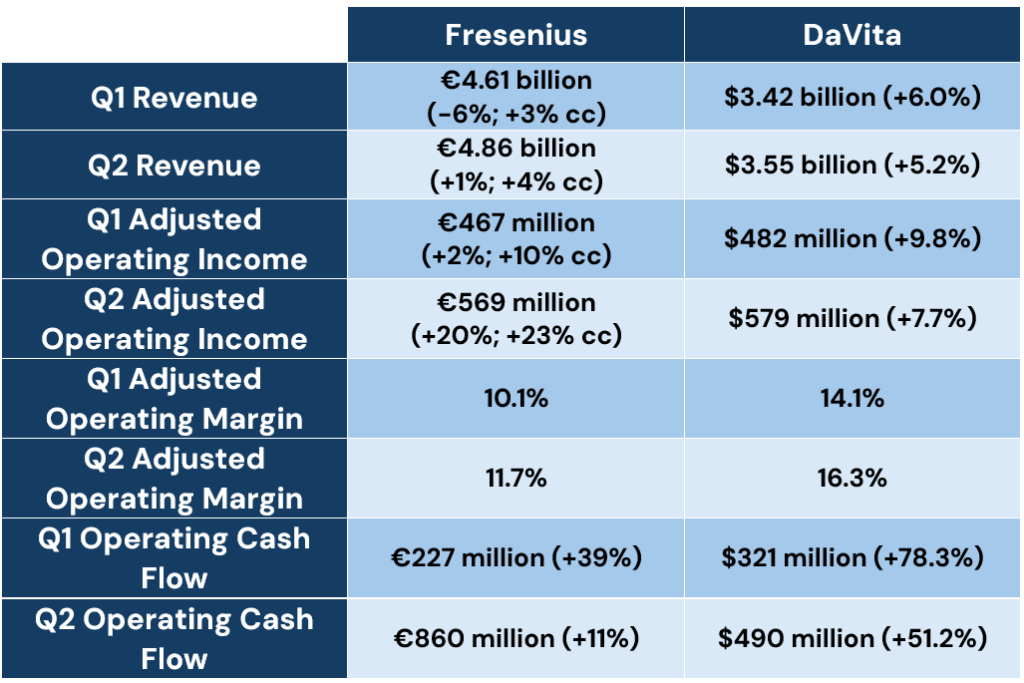
Key First Half 2026 Financial Metrics
Both companies improved first half profitability, although their reporting frameworks differ. Fresenius reports in euros and emphasizes constant currency, special item-adjusted growth, while DaVita reports in U.S. dollars under GAAP and supplements results with non-GAAP measures. The table below therefore retains each company’s reporting currency and uses YoY comparisons. Fresenius’s earnings improvement was driven primarily by Care Delivery, TDAPA and rate effects, and FME25+ savings, while DaVita benefited from higher revenue per treatment and cost discipline despite only modest treatment growth.
Segment & Service Line Performance
Fresenius Medical Care and DaVita remain heavily concentrated in dialysis, but their adjacent growth strategies differ. Fresenius combines Care Delivery, Care Enablement, and Value-Based Care, while DaVita pairs its core U.S. dialysis platform with Integrated Kidney Care and other ancillary and international operations. Across both companies, the key operating themes are muted U.S. treatment growth, reimbursement and rate realization, productivity, network optimization, and the expansion of value-based kidney care.
Fresenius Care Delivery: Care Delivery remained Fresenius’s primary earnings engine. In Q2, U.S. same-market treatment growth was -0.9%, but favorable rate effects, TDAPA reimbursement, revenue-cycle improvements, and FME25+ savings supported strong operating income growth excluding special items. Fresenius also completed its planned exits from approximately 100 selected U.S. clinics and had converted 227 U.S. clinics to the 5008X CAREsystem by late July, supporting broader adoption of hemodiafiltration, including high volume HDF.
Fresenius Value-Based Care: Value-Based Care continued to scale and showed meaningful profitability improvement. Q2 revenue reached €536 million, up 9% at constant currency, driven by higher member months and premium rates. Operating income excluding special items improved to €18 million in Q2 from a €9 million loss a year earlier, bringing first half operating income excluding special items to €26 million. The business remains subject to quarter-to-quarter earnings volatility inherent in risk-based arrangements.
DaVita U.S. Dialysis: DaVita’s core U.S. dialysis business remained the primary earnings driver. Normalized non-acquired treatment growth was 0.1% in Q1 and 0.3% in Q2, indicating modest rather than significant volume growth. Average patient service revenue per treatment was $416.71 for the first half, compared with $402.38 a year earlier, while Q2 patient care costs per treatment declined sequentially to $277.40 from $280.11 in Q1. The combination of pricing and cost discipline supported margin expansion despite limited volume growth.
DaVita Integrated Kidney Care & Ancillary Services: DaVita continued expanding its Integrated Kidney Care platform through risk-based and other integrated care arrangements. At June 30, 2026, approximately 64,900 patients were in risk-based arrangements representing roughly $5.8 billion of annualized medical spend. Integrated Kidney Care operating income improved from a $19 million loss in Q1 to $40 million income in Q2, producing $21 million operating income for the first half and illustrating both the growth opportunity and the quarter-to-quarter volatility of the model.
Overall, both companies are looking beyond treatment count growth as the sole source of earnings expansion. Fresenius is pursuing a more explicitly integrated model across provider delivery, dialysis products and technology, and value-based care, while DaVita’s near-term earnings remain more concentrated in U.S. dialysis, with Integrated Kidney Care serving as a smaller but increasingly important adjacent platform.
Full Year Outlook
Both companies maintained constructive full year outlooks. Fresenius Medical Care reaffirmed its 2026 guidance for broadly flat revenue growth and operating income growth between positive and negative mid-single digits; the guidance is stated at constant currency, with operating income excluding special items, and implies a 10.5%-12.0% operating margin. DaVita maintained its 2026 guidance for adjusted operating income of $2.15-$2.25 billion, adjusted diluted EPS of $14.10-$15.20, and free cash flow of $1.0-$1.25 billion. With normalized non-acquired treatment growth improving from 0.1% in Q1 to 0.3% in Q2, treatment volume remains a modest contributor rather than the principal earnings-growth driver.
Pinnacle’s Outlook
Pinnacle views the outlook as constructive but differentiated. Fresenius’s upside depends on rate and TDAPA benefits, FME25+ savings, clinic optimization, 5008X and HDF adoption, and continued Value-Based Care improvement offsetting negative U.S. same market treatment growth and other regulatory pressures. DaVita enters the second half with stronger reported margins and cash generation, but still depends on sustaining revenue per treatment, cost productivity, and modest volume growth. For both companies, the durability of margin expansion is the key issue to watch.