CMS’s Calendar Year (CY) 2027 Physician Fee Schedule (PFS) final rule includes some of the most significant Medicare Shared Savings Program (MSSP) updates in recent years. While many of the finalized changes are highly technical, the overall direction is clear: CMS is continuing to advance accountable care by making participation more attractive, more sustainable, and more flexible for provider organizations. The final rule continues CMS’s broader push toward value-based care through changes to MSSP financial incentives, quality reporting requirements, benchmark methodologies, and reporting flexibility. Three key themes emerge throughout the final rule:
- Increased flexibility for participating organizations;
- program refinements that respond to stakeholder feedback, and;
- continued support for coordinated care delivery across provider networks.
These finalized policies aim to improve financial sustainability, simplify program requirements, strengthen participation incentives, and encourage greater collaboration across care teams. For MSSP ACOs, the changes could influence track selection, quality reporting strategies, and approaches to benchmark management for PY 2027 and subsequent performance years. With the final rule now issued, organizations should evaluate the impact of these changes and plan for successful implementation.
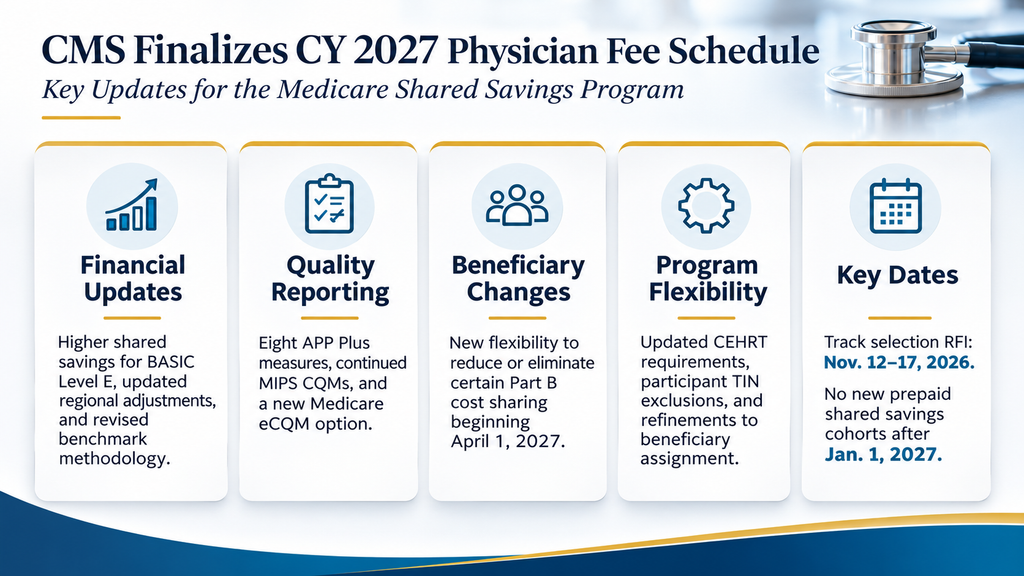
Why These Changes Matter
CMS is clearly focused on making accountable care models more attractive, sustainable, and operationally feasible, with flexibility serving as a key theme throughout the final rule. The finalized policies address longstanding concerns around benchmark methodology and financial sustainability by seeking to create a more stable environment that rewards long-term participation and continued performance improvement. At the same time, CMS remains committed to advancing value-based care by holding providers accountable for quality, care coordination, patient outcomes, and total cost of care. For MSSP ACO leaders, the message is clear: CMS is refining, not retreating from, accountable care as it works to expand participation and strengthen the program’s long-term success.
Financial Changes That Could Affect MSSP Strategy
Several of CMS’s finalized MSSP financial changes are intended to strengthen participation incentives, improve benchmark sustainability, and support long-term engagement in accountable care. For many ACOs, these updates could influence future shared savings opportunities, benchmark performance, and risk-track decisions.
- Higher Shared Savings for BASIC Level E ACOs: CMS finalized increasing the shared savings rate from 50% to 60%, potentially making BASIC Level E more attractive for organizations considering two-sided risk participation.
- Reduced Regional Adjustment for ENHANCED ACOs: CMS finalized reducing the maximum weight used in calculating the positive regional adjustment for lower-spending ENHANCED ACOs from 50% to 35%, which could affect benchmark performance and the track’s financial advantages.
- Recognition of Prior Savings Performance: The final rule increases the prior savings adjustment scaling factor from 50% to 75%, giving greater consideration to an ACO’s previous savings achievements and helping reduce disincentives for high-performing organizations to remain in MSSP.
- Reevaluating BASIC vs. ENHANCED Participation: Taken together, these finalized financial changes may alter the risk-reward balance between MSSP tracks, making financial modeling and track-selection analysis increasingly important for PY 2027.
- Benchmark and Financial Methodology Changes: CMS finalized modifications to the MSSP financial methodology intended to improve benchmark stability, address incentives created by benchmark rebasing, and better balance the financial incentives between BASIC Level E and ENHANCED. These include risk adjustment of the 5% cap on upward benchmark adjustments, a growth adjustment for recruiting professionals and beneficiaries new to value-based care, and Accountable Care Prospective Trend (ACPT) guardrails. For agreements beginning in 2027, the ACPT may be no more than 1 percentage point below or 1.5 percentage points above national growth. The lower guardrail also applies retroactively to certain existing agreements for PY 2025 reconciliation and later years.
Quality Reporting and Data Reporting Flexibility
Alongside the finalized financial changes, CMS is simplifying quality reporting requirements while providing ACOs with greater flexibility in how they collect, report, and manage performance data. Together, the finalized Alternative Payment Program (APM) Performance Pathway (APP) Plus, Medicare Electronic Clinical Quality Measures (eCQM), and Certified Electronic Health Record Technology (CEHRT) updates are intended to reduce administrative burden while preserving accountability for quality outcomes.
- Streamlined APP Plus Measure Set: CMS finalized reducing the APP Plus measure set to eight measures for PY 2027, removing Initiation and Engagement of Substance Use Disorder Treatment (Quality ID: 305) and Adult Immunization Status (Quality ID: 493) to simplify quality reporting.
- Continued Use of MIPS CQMs: ACOs may continue reporting through MIPS CQMs for PY 2027 and subsequent years, providing continuity for organizations with established reporting processes, while maintaining the 75% data completeness requirement. CMS also extended the MIPS CQM reporting incentive.
- New Medicare eCQM Reporting Option: CMS finalized a new Medicare eCQM pathway for PY 2027 and subsequent years that allows ACOs to report using data from their assigned Medicare beneficiaries, rather than all patients across all payers, offering greater flexibility for organizations with data aggregation challenges. ACOs using this option will not qualify for the eCQM/MIPS reporting incentive or Complex Organization Adjustment.
- Greater CEHRT Reporting Flexibility: Finalized changes provide three alternative ACO-level CEHRT use activities beginning in PY 2027, including eligible eCQM/Medicare eCQM reporting, reporting supported by a FHIR-based API, or attestation to an ACO CEHRT use metric. CMS also permits certain participant TIN exclusions from quality reporting beginning in PY 2026, subject to specified conditions, including coverage of at least 95% of assigned beneficiaries before measure specifications are applied; the 75% data completeness requirement still applies.
- Strategic Reporting Decisions for PY 2027: With additional reporting pathways and flexibility, ACOs will need to evaluate quality reporting strategies, technology capabilities, data management processes, and compliance requirements to determine the best approach.
Other MSSP Proposals to Watch
Beyond the finalized financial and quality reporting changes, CMS included several additional MSSP policies that could influence ACO participation, beneficiary engagement, and program administration. While narrower in scope, these changes reflect CMS’s continued effort to provide ACOs with greater flexibility while strengthening participation and reducing administrative barriers.
- Beneficiary Assignment Changes: CMS finalized changes to the beneficiary assignment methodology that could affect how certain primary care services are considered when determining ACO assignment. Updates to the primary care service code definition apply beginning PY 2027, while changes to non-ACO TIN billing and Medicare enrollment-based assignment eligibility apply beginning PY 2028. These changes are intended to better align beneficiary assignment with evolving Medicare payment policies.
- Part B Cost-Sharing Flexibility: CMS finalized allowing eligible ACOs, subject to CMS approval of an implementation plan, to reduce or eliminate certain Medicare Part B cost-sharing obligations for beneficiaries beginning April 1, 2027. Eligible items and services exclude durable medical equipment, prosthetics, orthotics, supplies, and prescription drugs. This could give ACOs another tool to encourage access to care and strengthen beneficiary engagement.
- Changes to Prepaid Shared Savings: CMS finalized eliminating the prepaid shared savings option for new ACO cohorts after the January 1, 2027 application cycle. ACOs already participating in the option may continue receiving payments through December 31, 2027. Organizations considering this payment option should evaluate the timing of their participation and potential implications for future care delivery investments.
- Greater Flexibility in Track Selection: CMS finalized allowing January 1, 2027 applicants an opportunity to revise their selected MSSP track during Phase 2 RFI, November 12–17, 2026, ending at 12:00 p.m. (noon) ET. This gives organizations additional flexibility to evaluate the final financial and regulatory environment before committing to a participation track.
- Continued Evolution of ACO Requirements: The finalized changes build on recent MSSP reforms intended to encourage participation in two-sided risk, provide greater flexibility around program requirements, and reduce administrative burdens. CMS also simplified beneficiary notification requirements beginning January 1, 2027, revised how certain ACO participant TINs count toward prior risk experience, and updated the advance investment payment methodology beginning PY 2028 to include rural eligibility criteria. For ACOs, the cumulative effect of these changes may be as important as any individual policy update, making ongoing evaluation of program requirements increasingly important for long-term strategy.
From Policy to Practice: Preparing for MSSP Changes
As CMS continues to refine MSSP, ACO leaders should look beyond individual policy changes and evaluate their broader financial, operational, and strategic implications. Key priorities include:
- Financial Strategy and Risk Alignment: Model the potential impact of benchmark adjustments, shared savings opportunities, and participation tracks to inform long-term strategy.
- Quality and Reporting Readiness: Evaluate reporting pathways, technology capabilities, and data infrastructure to identify gaps and ensure compliance.
- Operational Performance: Assess physician alignment, network performance, care coordination, and analytics capabilities to strengthen accountability and outcomes.
- Implementation Planning: Translate regulatory changes into actionable priorities, timelines, and operational adjustments.
While the finalized changes offer opportunities for greater flexibility and financial sustainability, success will depend on how effectively organizations translate policy into execution.
Pinnacle Healthcare Consulting works with ACOs, health systems, and physician organizations to navigate these complexities through strategic advisory, financial analysis, regulatory guidance, and operational support. Our focus is helping organizations make informed decisions, manage risk, and improve performance as accountable care continues to evolve.
Resource:
Centers for Medicare & Medicaid Services. Calendar Year (CY) 2027 Medicare Physician Fee Schedule Final Rule (CMS-1848-F) — Medicare Shared Savings Program. November 4, 2026. https://www.cms.gov/newsroom/fact-sheets/calendar-year-cy-2027-medicare-physician-fee-schedule-final-rule-cms-1848-f-medicare-shared-savings